

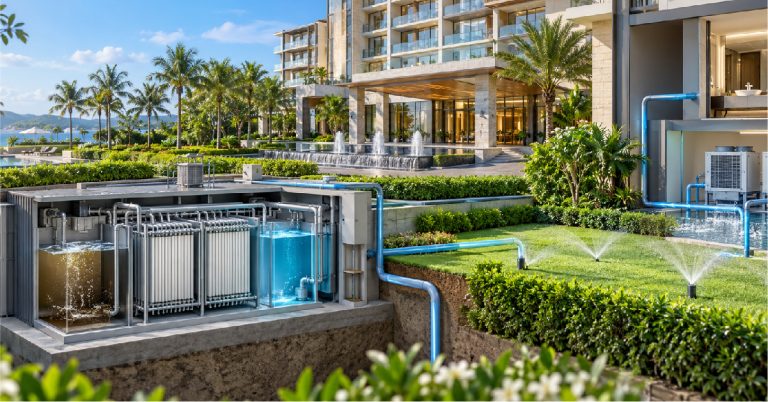
Hotels have an unusual water challenge. Guests expect spotless rooms, fresh linen, landscaped gardens, clean kitchens and reliable washrooms, yet every one of those services creates wastewater. At the same time, hotel properties rarely have unlimited space for treatment infrastructure.
That is where MBR Sewage Treatment becomes commercially interesting: it enables hotels to treat wastewater in a smaller footprint while producing high-quality treated water that can support non-potable reuse.
Why Conventional Sewage Treatment Can Be Difficult for Hotels
A hotel sewage treatment plant has to perform reliably despite changing occupancy. Weekend peaks, events, holiday seasons and low-occupancy periods can all alter wastewater flow and load. Conventional systems may also require separate clarification and filtration stages, increasing the space needed for treatment.
A compact sewage treatment plant can therefore create value beyond compliance. When treatment equipment requires less space, designers gain flexibility in basements, service areas or constrained plots, particularly in urban hotels and resorts where every square metre matters.
How MBR Sewage Treatment Works
This method involves biological treatment followed by membrane filtration. Biological organisms carry out the decomposition of organic materials while the membrane separates cleaned water from the solids suspended in it. Moreover, while in traditional biological treatment membranes do not require secondary clarification, in membrane separation a steady flow of treated water is secured.
For hotels, an MBR wastewater treatment system is especially relevant when the objective is not only safe discharge but also recovering water for suitable non-potable applications.
Why the Membrane Stage Matters
The membrane barrier retains suspended matter within the treatment process and supports reliable treated-water quality when the plant is correctly designed, operated and maintained.
Ion Exchange’s MBR portfolio combines submerged membrane filtration with biological treatment and is intended for domestic sewage and industrial wastewater applications, including reuse.
Space Saving Is More Than a Design Benefit
For a city hotel, the cost of an oversized treatment area is easy to underestimate. Plant rooms compete with parking, storage, kitchens and utilities. At a resort, the same infrastructure may compete with landscaping, recreational zones or future expansion.
A membrane bioreactor for hotels can reduce this pressure because the process may eliminate or reduce some conventional settling and polishing stages.
The hypothesis presented here is straightforward: as the amount of land available is restricted, the valuation of treatment technology should not solely depend on its cost.
This is especially relevant for hotels that are in urban areas since the additional ground that can be saved has huge value compared to that in a typical industrial building. Smaller treatment footprint gives engineers more opportunities to design service areas, amenities offered to guests and future extensions..
Wastewater Reuse in Hotels Can Reduce Freshwater Demand
Hotels consume water across flushing, landscaping, cooling, housekeeping and utility operations. Not every application needs potable-quality water.
With appropriate treatment, disinfection and site-specific compliance measures, wastewater reuse in hotels can support applications such as toilet flushing, gardening and selected utility uses. This gives treated wastewater a second purpose instead of viewing it only as something to discharge.
An MBR sewage treatment plant can be useful here because membrane separation creates a high-quality treated stream that can form the basis of a reuse system. Depending on the intended application, additional disinfection or polishing may still be required.
From a hotel management perspective, this changes the conversation. Wastewater treatment is no longer simply an expense required for environmental compliance. It becomes part of the property’s broader water-management strategy.
What Hotels Should Check Before Choosing an MBR System
Buying an MBR wastewater treatment system purely on rated capacity is risky. Hotel wastewater patterns are rarely flat, and plant performance depends on more than average daily flow.
Management teams of the facility need to look at peak occupancy and kitchen wastewater production, laundry services, seasonal requirements, available space, smell control, sludge disposal, as well as reuse concepts. The review should also include membrane cleaning, energy consumption, operator skills and accessibility for maintenance.
In hotels, membrane bioreactors are effective when integrated into the overall water system of the establishment. For example, if reclaimed water is to be used for gardening, seasonal irrigation requirements need to be analyzed. If reuse of treated water for toilet flushing is anticipated, storage and distribution facilities must be planned.
In summary, the treatment plant should not be designed as a standalone entity, but as part of the water system economy.
Why Ion Exchange Is a Strong Partner for Hotel Wastewater Management
Ion Exchange has provided water and wastewater management solutions in Nepal for more than three decades and serves hotels alongside other industrial, institutional and community segments. Its service capabilities include operations and maintenance, rehabilitation, consumables, audits and consultancy.
For hotel projects, Ion Exchange offers INDION MBR solutions that combine biological treatment with membrane filtration. Its portfolio also includes compact MBR options for smaller capacities and packaged sewage treatment systems for decentralised applications.
That breadth matters because the right hotel sewage treatment plant should be selected around the site, not forced into a standard template. A resort with seasonal swings may need a different configuration from a business hotel with limited basement space.
For hotels planning new properties or upgrading ageing infrastructure, working with a water-management specialist also creates an opportunity to consider treatment, reuse and long-term plant performance together rather than purchasing isolated pieces of equipment.
Turning Wastewater Into a Hotel Resource
For hotels, treated sewage is no longer only a compliance issue; it can become part of a broader water-efficiency strategy.
MBR Sewage Treatment helps make that shift practical by combining compact treatment with treated-water quality that can support reuse. When properly engineered, an MBR sewage treatment plant can help hotels protect valuable space, reduce dependence on freshwater for non-potable needs and strengthen operational resilience.
If your property is evaluating a new compact sewage treatment plant or upgrading an existing one, speak with Ion Exchange about a site-specific treatment and reuse strategy. The right solution should not simply treat wastewater; it should make the property’s entire water system work harder.
Frequently Asked Questions
1. What is an MBR system in hotel wastewater treatment?
It combines biological treatment with membrane filtration to remove organic matter and suspended solids from wastewater. Hotels often consider it where space is limited or high-quality treated water is needed for reuse.
2. Can MBR-treated water be reused in hotels?
Yes, subject to local regulations and the required end-use quality. Wastewater reuse in hotels may support toilet flushing, landscaping and selected utility applications after suitable treatment and disinfection.
3. Is MBR more compact than conventional sewage treatment?
In many applications, yes. A compact sewage treatment plant using membrane separation can reduce reliance on conventional clarification and some downstream filtration stages. Final space requirements depend on project design.
4. What should hotels consider before installing an MBR plant?
Hotels should assess wastewater flow, peak occupancy, influent characteristics, reuse goals, available space, membrane maintenance, energy demand, sludge handling and operator requirements.
5. Does an MBR plant need regular maintenance?
Yes. Membrane cleaning, biological-process monitoring, equipment checks and scheduled maintenance are essential for reliable performance and treated-water quality.