

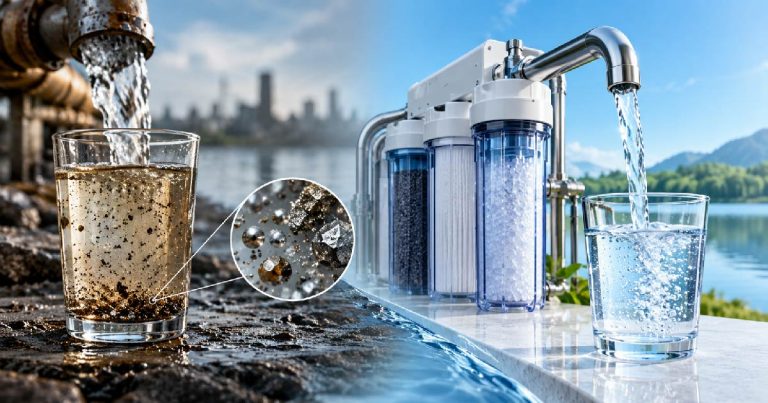
Clear water can still contain a problem you cannot see, smell or taste.
That is what makes heavy metals in drinking water particularly concerning. Unlike visible sediment or an unusual odour, dissolved metals may go unnoticed unless the water is tested. Some occur naturally as water moves through rock and soil. Others may enter water through industrial activity, waste disposal, mining or even the plumbing used to deliver water to a building.
Not every trace of a metal automatically makes water unsafe. The real concern is prolonged or excessive exposure to toxic elements such as lead, cadmium, chromium, mercury and arsenic, which is technically a metalloid but is commonly considered alongside heavy-metal contamination.
Understanding where these contaminants come from is the first step towards managing the risk.
How Do Heavy Metals Get Into Drinking Water?
There is rarely one universal source of heavy metal contamination in water.
Groundwater can pick up naturally occurring minerals as it moves through geological formations. Arsenic is a well-known example. WHO identifies contaminated groundwater as an important source of inorganic arsenic exposure in several parts of the world.
Other contamination starts above ground. Industrial discharge, metal processing, mining, poorly managed waste and polluted runoff can introduce metals into rivers, lakes and groundwater.
Then there is the distribution system itself.
Lead, for instance, can enter drinking water after treatment if the water comes into contact with plumbing components containing lead. WHO specifically identifies pipes, solder and fittings as potential sources.
This is why water quality cannot be judged only at its source. What happens between the source, treatment plant, storage system and final tap also matters.
Which Heavy Metals in Drinking Water Deserve Attention?
Different contaminants behave differently in water and affect health in different ways. A few deserve particular attention.
Arsenic
Natural occurrences of arsenic can happen in groundwater sources. Studies show a link between exposure to inorganic arsenic in drinking water and skin conditions, as well as cancer cases of the skin, bladder, and lung. Additionally, WHO found a possible connection between inorganic arsenic and various diseases related to health conditions and infections.
Arsenic can go undetected in drinking water due to the fact that changes in taste and appearance of water may not occur.
Lead
Lead contamination often has less to do with the original water source and more to do with the materials that water touches on its way to the consumer.
Children are especially vulnerable to lead exposure because it can affect development of the nervous system. In adults, prolonged exposure has been associated with effects including cardiovascular problems and kidney damage. WHO states that there is no known level of lead exposure that is without harmful effects.
Cadmium
Cadmium may enter the environment through industrial processes, waste and certain metal-related activities. Long-term exposure is of concern because cadmium can accumulate in the body, particularly affecting the kidneys.
Its presence in drinking water should therefore be investigated as part of a wider assessment of drinking water contaminants rather than considered only when visible pollution is present.
Chromium and Mercury
Chromium can exist in different forms, and its health hazards depend on its form. Industrial processes may also increase the possibility of chromium being introduced in water.
Mercury pollution can be caused by both natural and anthropogenic factors. As with other pollutants, the form of mercury and the composition of water affect its behaviour and treatment.
The take-home message is as follows: it is not sufficient to know the presence of “metal pollution.” One must also know the particular metal and its concentration before deciding what treatment to apply.
Water Contamination Health Effects Are Often Long-Term
One reason people underestimate chemical contamination is that it does not always cause an immediate reaction.
Microbial contamination happens very quickly. The adverse effects of water poisoning with dangerous metals are noticeable after recurrent exposure over a long period.
Knowing the difference is essential.
People can drink water for years on a daily basis and never notice the contamination effectively absent. As per the WHO, long-term exposure to arsenic can take years before the effects become evident.
Children, pregnant women, and long-exposed adults may suffer different levels of harm depending on the toxin.
Thus, it is vital to focus on prevention, which consists of discovering the exposure to toxins before the symptoms appear.
Testing Comes Before Treatment
It is tempting to start with a purifier or treatment technology. That reverses the order of the problem.
First find out what is in the water.
A proper laboratory analysis can establish whether heavy metals in water are present and at what concentration. It can also reveal other water characteristics that influence treatment, including pH, hardness, dissolved solids and competing ions.
Ion Exchange Nepal also highlights regular water-quality monitoring as an important part of identifying contamination and maintaining safe water quality.
Testing becomes especially important when groundwater is the primary source, industrial activity exists nearby, the source quality changes seasonally or there is reason to suspect contamination from older plumbing.
Choosing the Right Heavy Metal Removal From Water Process
There is no single treatment method that removes every metal equally well.
That is where treatment decisions become more technical.
Ion Exchange
Ion exchange uses specially designed resins to exchange undesirable ions in water for other ions held by the resin.
Depending on the resin and water chemistry, the process can target particular ionic contaminants. The US EPA, for example, identifies anion exchange as a treatment option for contaminants including arsenic and chromium-6.
Ion Exchange Nepal offers INDION resins for applications including potable and industrial water treatment.
Reverse Osmosis and Membrane Treatment
Reverse osmosis uses a semi-permeable membrane to separate a broad range of dissolved substances from water. EPA identifies RO as useful for removing many inorganic contaminants and dissolved solids.
Performance, however, depends on membrane selection, feed-water quality, pretreatment and operating conditions.
Coagulation and Filtration
Some metal contaminants can be converted or associated with particles that can then be separated through coagulation, clarification and filtration.
Arsenic treatment is one example where carefully designed coagulation-based treatment may form part of the solution.
The important point is that heavy metal removal from water should follow analysis. Installing technology first and investigating the contaminant later can lead to poor removal performance and unnecessary cost.
Prevention Should Cover the Entire Water System
Managing heavy metals in water is not only about installing a treatment unit.
Protection at the source is very important. Industrial wastewater management is necessary to prevent contaminants from entering the groundwater or surface waters at first. The distribution systems must also be monitored.
This means that although treatment may make the water acceptable, if old pipelines introduce it into the water supply, the source of the issue has only been shifted. The process should also include ongoing assessment and verification of the water supply to make sure that the water quality has not changed.
How Ion Exchange Supports Safer Water Treatment in Nepal
Ion Exchange has provided water and wastewater management solutions in Nepal for more than three decades, serving industries, institutions, communities and homes. Its portfolio includes water treatment systems, potable-water solutions, INDION ion exchange resins and HYDRAMEM membrane technologies.
That breadth becomes useful when dealing with drinking water contaminants because the correct solution may require more than one treatment barrier.
Rather than treating every case of heavy metal contamination in water in the same way, the treatment process should be based on the contaminant profile, required water quality and operating conditions.
Final Thoughts
Heavy metals in drinking water are easy to overlook because the water may appear completely normal. That makes testing, rather than visual inspection, the starting point for protection.
Once the contaminant and concentration are understood, technologies such as ion exchange, membrane treatment or properly designed clarification and filtration can be evaluated for the specific application.
If you are concerned about water quality or need a treatment system designed around your source-water conditions, connect with Ion Exchange experts to assess the water and determine an appropriate treatment approach.
FAQs
What are the most common heavy metals found in drinking water?
Lead, cadmium, chromium and mercury are among the metals of concern. Arsenic, although technically a metalloid, is also frequently discussed with toxic metal contamination because of its importance in drinking-water safety.
Can boiling water remove heavy metals?
No. Boiling is primarily useful for controlling many microbial hazards. It does not provide a reliable method of heavy metal removal from water, and evaporation may leave dissolved contaminants behind.
How can I know if drinking water contains heavy metals?
Laboratory testing is the reliable way to identify heavy metals in drinking water because many dissolved contaminants do not produce an obvious colour, taste or smell.
What causes heavy metal contamination in water?
Possible sources include natural geology, mining, industrial discharge, waste disposal, polluted runoff and corrosion or leaching from plumbing materials.
Which treatment method removes heavy metals from water?
The appropriate process depends on the specific contaminant, its concentration and the overall water chemistry. Ion exchange, reverse osmosis and selected coagulation or filtration processes may be considered after proper water analysis.