

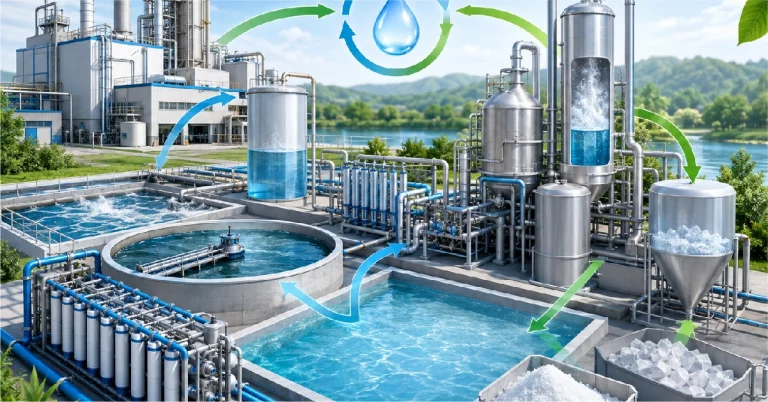
Industrial wastewater can contain organic matter, chemicals, suspended solids, dissolved salts, oils, and other contaminants that vary significantly from one industry to another. This makes a standard treatment approach unsuitable for every facility.
Modern Effluent Treatment Plant Manufacturers are therefore moving beyond basic treatment systems towards customised solutions that combine biological, chemical, membrane, and advanced treatment technologies.
For industries in Nepal, these wastewater solutions can help address effluent-treatment requirements while creating opportunities for water recycling, resource recovery, and more sustainable operations.
What Is an Effluent Treatment Plant?
An Effluent Treatment Plant (ETP) is designed to treat wastewater generated by industrial processes before the treated water is discharged or reused.
Depending on the industry, effluent may contain:
- Organic pollutants
- Suspended solids
- Chemicals
- Oils and grease
- Dissolved salts
- Heavy metals
- Industry-specific contaminants
The treatment process is selected according to the wastewater characteristics, flow rate, required treated-water quality, available space, and reuse objectives.
Why Modern ETP Solutions Are Important in Nepal?
Industrial facilities need wastewater treatment systems that can handle changing wastewater loads while maintaining reliable treatment performance.
An effective ETP can help industries:
- Reduce wastewater pollution
- Meet applicable environmental requirements
- Reuse treated water
- Reduce freshwater consumption
- Improve resource efficiency
- Reduce pollution-related risks
Ion Exchange’s wastewater-treatment framework identifies compliance, freshwater savings through recycling, sustainability, resource recovery, and reduced pollution-related liabilities among the key benefits of wastewater treatment systems.
How Modern Effluent Treatment Plants Work?
A modern industrial wastewater treatment system can combine several stages depending on the type of effluent.
-
Primary Treatment
Screening, grit removal, equalisation, and sedimentation help remove larger solids and reduce the initial pollutant load.
-
Chemical Treatment
Neutralisation, coagulation, and flocculation can help remove suspended solids, colour, oils, metals, and other contaminants.
-
Biological Treatment
Biological processes use microorganisms to break down biodegradable organic matter.
Technologies include:
- Activated sludge
- MBBR
- SBR
- MBR
-
Tertiary Treatment
Where higher-quality treated water is required, additional filtration, membrane treatment, disinfection, or RO can be incorporated.
The final configuration depends on whether the water is intended for discharge, utilities, or further reuse.
Advanced Technologies Used by ETP Plant Manufacturers
Technology selection is one of the key factors differentiating modern ETP plant manufacturers.
-
MBBR Technology
Moving Bed Biofilm Reactor technology uses biofilm carriers to enhance biological treatment and can be used where higher biological treatment capacity is required.
-
SBR Technology
Sequencing Batch Reactor technology performs treatment in batches, combining biological treatment and settling within the treatment cycle.
-
MBR Technology
Membrane Bioreactor technology combines biological treatment with membrane filtration to produce high-quality treated effluent.
-
Reverse Osmosis
RO can provide advanced removal of dissolved salts and impurities when treated wastewater needs to be further purified for reuse.
-
Zero Liquid Discharge
ZLD systems combine processes such as RO, evaporation, and crystallisation to maximise water recovery and eliminate liquid discharge where required.
How ETP Manufacturers Support Industrial Water Recycling?
Modern industrial water recycling solutions are increasingly designed around recovering useful water from wastewater rather than treating effluent only for disposal.
A typical recycling approach is:
Industrial wastewater → ETP → Advanced treatment → Recovered water → Reuse
Depending on the required quality, recovered water can potentially be used for:
- Cooling
- Irrigation
- Cleaning
- Flushing
- Utilities
- Selected industrial processes
The treatment system should always be designed according to the required quality of the intended reuse application.
Industries That Need Effluent Treatment Solutions
Different industries generate different types of wastewater and therefore require different treatment approaches.
-
Pharmaceuticals
Pharmaceutical manufacturing can generate complex chemical effluents that require specialised treatment.
-
Textiles
Textile wastewater can contain dyes, chemicals, suspended solids, and organic pollutants requiring chemical and biological treatment.
-
Food & Beverage
Food-processing wastewater is often rich in biodegradable organic matter and can require biological treatment.
-
Chemicals
Chemical industries may generate high-TDS and hazardous effluents requiring customised treatment.
-
Power
Power plants generate wastewater from different utility and process operations and may require water recycling to reduce freshwater consumption.
These industries are identified as key users of wastewater treatment systems because of their specific effluent characteristics and treatment requirements.
How to Choose the Right ETP Plant Manufacturer in Nepal?
Choosing the right Effluent Treatment Plant Manufacturer requires more than comparing equipment specifications or installation costs.
-
Understand Your Effluent
The manufacturer should assess flow rate, BOD, COD, TSS, pH, TDS, chemicals, and other relevant contaminants.
-
Evaluate Technology Capability
A suitable partner should have access to biological, chemical, membrane, and advanced treatment technologies.
-
Consider Water Reuse
If the objective includes recycling, the ETP should be designed around the required reuse quality from the beginning.
-
Assess Available Space
The plant footprint can influence the choice between conventional and compact treatment technologies.
-
Look at Lifecycle Support
Operation, maintenance, process optimisation, technical assistance, and spare-parts support can influence long-term plant performance.
Ion Exchange Effluent Treatment Plant Solutions
Ion Exchange provides customised effluent treatment plant solutions by integrating biological, membrane, and filtration technologies according to individual wastewater characteristics and treatment objectives.
Its wastewater-treatment portfolio includes:
- ETP systems
- MBBR
- SBR
- MBR
- RO
- Water recycling systems
- ZLD solutions
- Advanced wastewater treatment
Ion Exchange also provides complete water and wastewater treatment capabilities, allowing ETP systems to be considered alongside water recycling and other industrial water requirements.
For Nepal, this integrated approach is particularly relevant as the country’s existing search demand already shows strong interest in industrial wastewater treatment, MBR technology, wastewater treatment services, and water treatment plant suppliers.
Why Innovative ETP Solutions Matter for Nepal?
The future of industrial wastewater treatment is moving towards systems that do more than meet discharge requirements.
Advanced ETP solutions can help industries:
- Recover treated water
- Reduce freshwater dependency
- Improve treatment efficiency
- Manage changing wastewater characteristics
- Support sustainability objectives
- Reduce pollution risks
For industries with high water consumption or stringent treatment requirements, combining ETP treatment with recycling, membrane purification, or ZLD can provide a more comprehensive water-management strategy.
Conclusion
Modern Effluent Treatment Plant Manufacturers are increasingly combining biological, chemical, membrane, and advanced treatment technologies to address complex industrial wastewater requirements.
For industries in Nepal, the right ETP solution can help manage effluent responsibly while creating opportunities for water recycling, resource recovery, and sustainable industrial operations.
Ion Exchange provides integrated wastewater-treatment technologies and customised solutions based on wastewater characteristics, treatment objectives, and reuse requirements.
Connect with Ion Exchange experts for customised ETP systems, industrial wastewater treatment, water recycling, and advanced wastewater solutions in Nepal.
FAQs
-
What does an effluent treatment plant manufacturer do?
An ETP manufacturer designs and supplies systems that treat industrial wastewater. Depending on the project, services can include engineering, installation, commissioning, and lifecycle support.
-
What technologies are used in modern ETP plants?
Modern ETPs can use activated sludge, MBBR, SBR, MBR, filtration, RO, and ZLD technologies depending on the wastewater characteristics and required treated-water quality.
-
Can an ETP plant support water recycling?
Yes. Treated effluent can undergo additional purification and be reused for suitable applications such as cooling, utilities, irrigation, cleaning, and selected industrial processes.
-
How do I choose an ETP plant manufacturer in Nepal?
Consider the manufacturer’s industry experience, technology portfolio, customisation capability, project execution expertise, water-reuse capabilities, and long-term technical and O&M support.
-
Which industries require ETP solutions?
Industries such as pharmaceuticals, textiles, chemicals, food and beverage, power, and other manufacturing sectors may require ETP systems depending on their wastewater generation and applicable environmental requirements.